
A Devil of a Problem – More Thoughts on Comic Books and Film
By Wil Forbis
March 2, 2003
Of Related Interest:
Spider Man, We Hardly Knew Ye - Initial look at transferring comic book characters to the screenBeing, Emptiness and Spandex Tights with the Underwear on the Outside - Max Burbank's hilarious addiction to comics.
Review of Spider-Man - Tony P looks at the film.
Some years ago, I wrote a humorous article entitled “Spider-Man, We hardly Knew Ye,” which examined the difficulty Hollywood seemed to have adapting comic book superheroes to film. After viewing the newest comic book movie, "Daredevil," I feel the time is right to again tackle this important issue. Will this, too, be a humorous article? Probably not. With everything I’ve been through in the past year – the syphilis breakout and my divorce from the high profile rapper/actress Eve, (caused, in many ways, by the syphilis) I feel that any lighthearted attempts at comedy are beyond my abilities.
Let’s get to the meat of the lasagna: Did I like “Daredevil”? Well, it’s a splendid action film, with a compelling sense of aesthetics. Scenes of Ben Affleck’s Daredevil acrobatically leaping across the New York landscape are equal to Toby Maguire’s Spider-Man swinging across the New York landscape. Sequences showing Colin Farrell’s Bullseye using paper clips, playing cards and Daredevil’s own truncheon as deadly missiles are akin to “The Matrix.” And Michael Clarke Duncan, playing a racially altered representation of Marvel Comic’s “Kingpin” character is a sight to behold – a dark-skinned Sumo with sinewy musculature.
But when you got down to matters of plot, dialogue and characterization, I can only quote numerous comic book heroes who have found themselves on the receiving end of a laser blast or electrified bullwhip: “Aaaaarrrghhhhhh!” Every phrase spoken by every character in the film will make you cringe with its banality and triteness. Observe this stirring tête-à-tête between Daredevil and ElektraDaredevil: “I didn’t kill your father!”Elektra: “Liar!”(Unable to resolve this issue through discourse, the two commence fighting, much the chagrin of the French.)
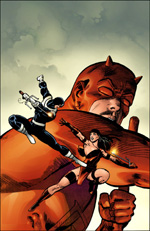
Of course, a lot of people will say, “Gee, that doesn’t sound much different from your average comic book dialogue.” And they’re right. The average comic book is pretty stupid, promoting a world of black and white morality occupied by colorfully clad defenders who scream out clichés like “I want justice!!!” or “You can run from the law, but you cannot escape the evil in your soul!” before pummeling a bad guy into submission. But you gotta understand… “Daredevil” was never your average comic book. It started out in the early sixties, and was clearly a kid brother to more successful Marvel Comics titles like “Spider-Man” and “The Fantastic Four.” While the character was based on an interesting premise – a blind superhero whose other senses had become so powerful he was able to become a dangerous foe of evil – Daredevil never seemed to find his role in the Marvel Universe. Was he truly a “devil” who worked outside the law as a punishing vigilante, or was he more of a goody-two-shoes square in the Superman vein? In the seventies, Daredevil was passed between a string of writers and artists, none of whom seemed to have a consistent vision for what to do with the character. This changed in 1981, when both the writing and artwork were taken over but the now legendary Frank Miller. It was in Miller’s hands that Daredevil departed from the average, causing the world of comic books to undergo a fundamental change. Miller, while acknowledging the essential silliness of men in tights, treated the comic book art form seriously, and started scripting epic adventures that dealt with grandiose themes of religion, spiritual failure, inner city violence, politics and redemption. With Miller’s prodding, comic books moved one step away from their roots as pre-teen fodder towards a form of storytelling that could be enjoyed by adults. Soon other characters were following suit. Iron Man became an alcoholic. Thor sported a beard and reverted to his Viking roots. The X-Men’s Wolverine, a principled but unapologetic killer, became one of comic’s most popular characters. In a move that attracted the most attention, DC Comic’s Bat-Man was reinvented (again by Miller) as a dark knight willing to use a savagery surpassing that of his enemies to fight injustice.
So where did the movie “Daredevil” go wrong? After all, it was obviously influenced by Miller’s classic “Daredevil” issues, as the film’s three antagonists, Elektra, Bullseye and the Kingpin, were major players during Miller’s run on the book. I think there’s a couple points to consider. One, Miller himself had a hard time transferring his ideas to film, as was shown when he wrote the second in the series of RoboCop films. (A dismal failure.) Miller also had several years to play out his ideas and concepts in the Daredevil comic, whereas the creative forces behind the movie had to present it all in a few hours. The impression I got while watching the film was that it was trying to cram too much mythos into too small a timeframe. The film had to unravel the story of Daredevil’s origin, detail his love affair with Elektra, introduce the character of Bullseye and make clear that the Kingpin is the mastermind of New York’s criminal underground – while still leaving room for the required scenes of violence and death. Instead of trying to succeed splendidly in one area, the film fails equally in all. This is a movie that simply bit off more than it could chew.
I also question that choice of Ben Affleck as the lead character. For years I’ve seen the guy on film and been rather ambivalent towards his abilities. After seeing “Daredevil,” I have to ask: Can this guy really act? Daredevil himself may be blind as a vigilante, but Affleck seems blind as a thespian, and never really convinces the viewer of his passion for defending the weak against the strong. I almost expected him to start uttering pronouncements like, “I want justice…. Dude!” (I assume Affleck’s friendship with movie director and occasional Daredevil comic scribe, Kevin Smith, has something to do with why he was chosen for the role.)
The other actors fare better. Jennifer Garner, who plays Elektra could have simply gotten by on that fact that she’s a such hot piece of ass, but does a pretty commendable job. Michael Clark Duncan is definitely the best actor of the group, and gives the The Kingpin a menacing varnish. I don’t see the homicidal Bullseye as a particularly difficult part to play, but I can say that Colin Farrell doesn’t screw it up.
In general, I think things have gotten better in the world or comic book films. Last year’s “Spider-Man” was flawed, but still very enjoyable. I had no qualms with the first “X-Men.” The Blade series, featuring a little known comic book hero, is pretty damned good. But I can’t help feel that Daredevil's visually stunning introduction to celluloid is a step backwards.
What do you think? Leave your comments on the Guestbook!
Wil Forbis is a well known international playboy who lives a fast paced life attending chic parties, performing feats of derring-do and making love to the world's most beautiful women. Together with his partner, Scrotum-Boy, he is making the world safe for democracy. Email - acidlogic@hotmail.com
Visit Wil's web log, The Wil Forbis Blog, and receive complete enlightenment.